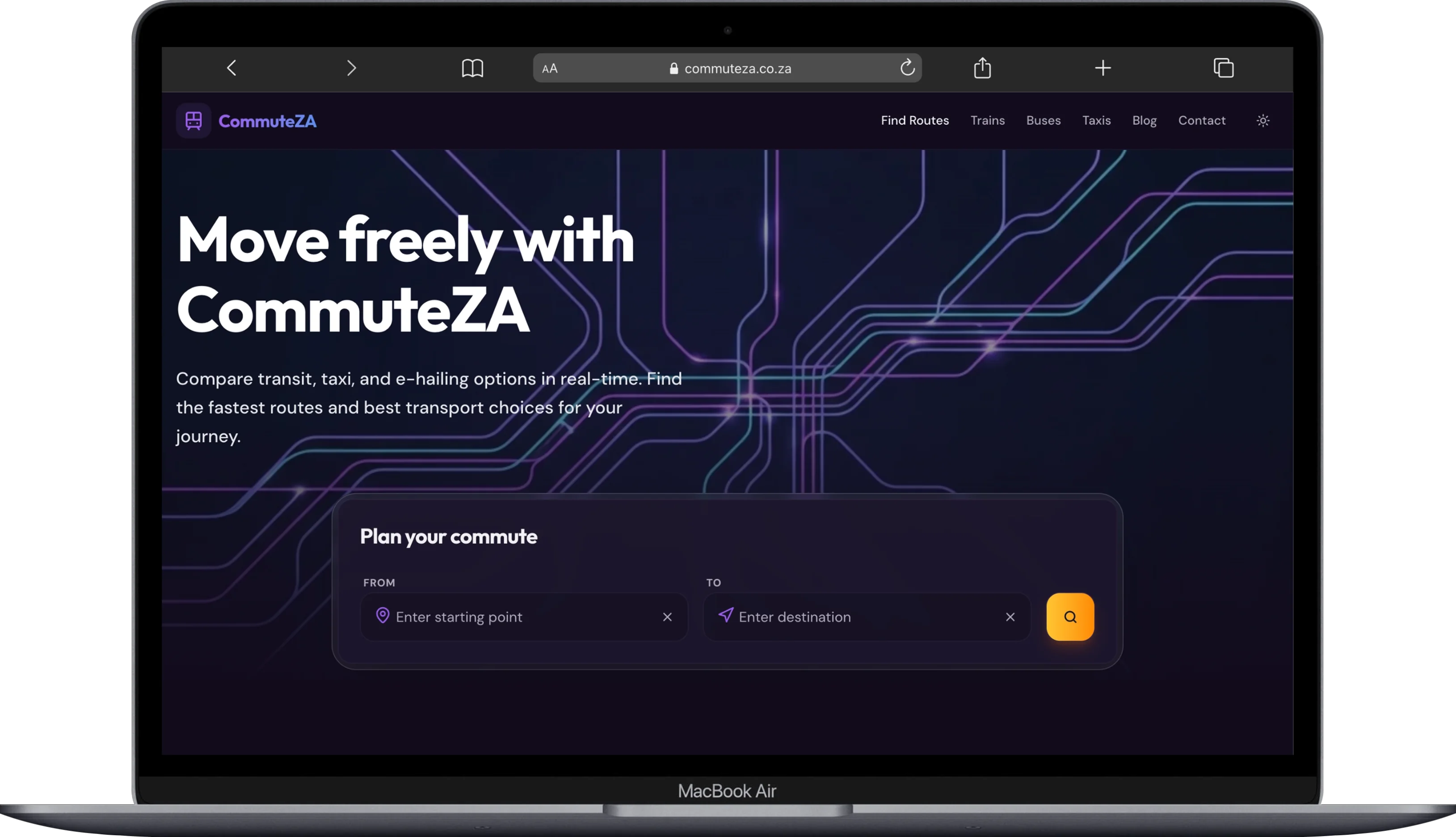
A routing web app for South African commuters, built from the ground up to deepen systems understanding and put SEO architecture into practice at a product level.
commuteza.co.za
A self initiated build designed to close the gap between SEO theory and systems implementation.
Most SEO work happens on platforms you don't own, constrained by CMS limitations, development timelines, and third party tooling. CommuteZA was built to change that. By owning the full stack, every SEO decision, from rendering strategy to URL structure, is deliberate, testable, and measurable.
The project serves South African commuters navigating public transport routes, while doubling as a live SEO laboratory where architecture decisions have real crawling and indexation consequences.
Built the platform on a headless CMS to gain granular control over metadata, structured data, and URL structures, removing the SEO constraints of traditional monolithic platforms.
Implemented and refined an SSR approach to ensure all content is fully rendered before reaching search engine crawlers, maximising crawlability and indexation speed.
Deployed comprehensive Schema.org markup tailored to the routing and commuter context, improving rich result eligibility and entity understanding.
Designed a systematic redirect architecture and URL structure to ensure clean canonical paths, avoiding duplicate content and preserving link equity as the platform scales.
Centralised metadata management through the CMS layer, allowing dynamic title and description generation at scale without manual intervention per page.
Currently working on the redirect logic in the CMS and looking to add pricing info. The platform is live at commuteza.co.za and continues to evolve as new SEO systems are implemented and tested in production.
CommuteZA gives me a controlled environment to test SEO architecture directly. It shows how I think about rendering, metadata, URL structure, schema, reporting, and technical tradeoffs when I can own the full stack.
The project focuses on implementation decisions that affect crawlability and indexation, including server side rendering, structured data, metadata systems, canonical paths, redirect logic, and search performance measurement.
No. The site is still in active development, so the metrics are early signals rather than a finished growth story. The value of the case study is the live implementation process and the way each SEO decision can be tested in production.
Progress is reviewed through Google Search Console, GA4, Google Tag Manager, PageSpeed Insights, Lighthouse, and AI visibility checks across surfaces such as AI Overviews and Microsoft Copilot.